
 Available in US
How Bookmakers Set Odds: Explained
Most people think bookmakers are gambling when they set odds on sporting events. They’re not. They’re doing something much closer to what actuaries at insurance companies do—calculating risk, pricing uncertainty, and building in margins that guarantee profit regardless of outcomes. The difference is that actuaries work with decades of mortality data while bookmakers are pricing events that haven’t happened yet based on incomplete information.
Understanding how odds actually get set changes everything about how you approach sports betting. You stop seeing bookmakers as adversaries trying to guess outcomes better than you, and you start seeing them as market makers building in fees for facilitating bets between people with opposing opinions. That shift in perspective is worth more than any betting system or handicapping method you’ll ever learn.
The odds you see on your screen aren’t attempts to predict the future perfectly. They’re prices designed to attract roughly equal betting action on both sides while ensuring the bookmaker profits from the transaction fees baked into those prices. Sometimes the odds reflect genuine probability assessments. Other times they reflect where the bookmaker thinks public perception differs from reality. Often they’re a mixture of both, adjusted constantly as new information arrives and betting patterns emerge.
This guide breaks down exactly how bookmakers construct odds, from the mathematical foundations of probability through the psychological factors that influence line movement. We’ll cover the technical stuff—over-rounds, implied probability, margin calculation—but we’ll also dig into why odds vary between bookmakers, how sharp money moves lines, and most importantly, how you can use this knowledge to identify value bets that offer positive expected value over the long term.
Think of this as a peek behind the curtain at the mechanisms that make sports betting work. Once you understand how the sausage gets made, you make better decisions about which sausages to buy.
Once you understand the price, explore the various betting markets explained in our guide.
Probability Basics: The Mathematical Foundation
Probability is just the likelihood of something happening expressed as a number between zero and one, or as a percentage between 0% and 100%. A coin flip has a 50% probability of landing heads. Rolling a six on a standard die has a 16.67% probability. These are simple examples where we can calculate exact probabilities because the possible outcomes are known and equally likely.
Sports betting deals with much messier probability because outcomes aren’t equally likely and depend on thousands of variables. But the mathematical principles remain the same. If you believe the Chiefs have a 60% chance of beating the Broncos, that’s a probability assessment. Converting that probability into odds requires some simple math.
The formula for converting probability to decimal odds is straightforward: divide 1 by the probability expressed as a decimal. If the Chiefs have a 60% chance of winning (0.60 as a decimal), the true fair odds are 1 divided by 0.60, which equals 1.67. Bet $100 at 1.67 odds and you’d receive $167 total back if you win—your $100 stake plus $67 profit.
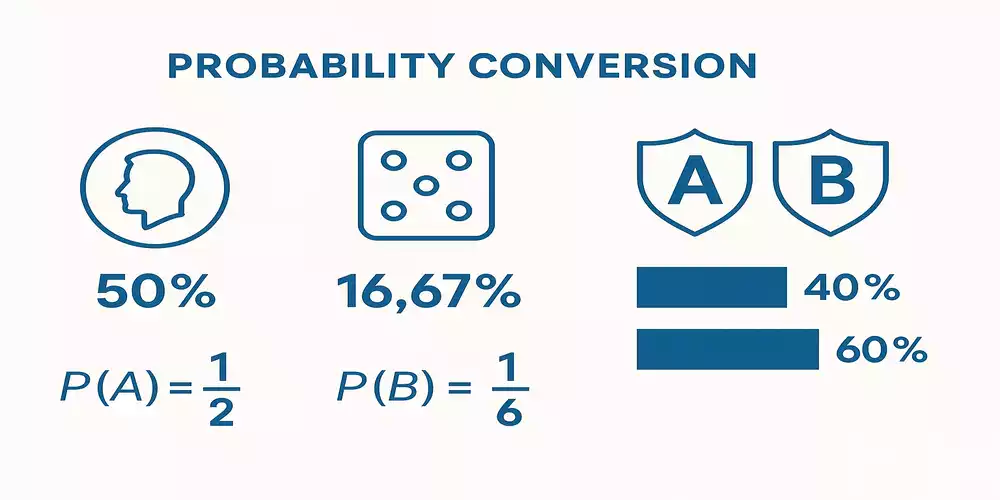
This concept of “fair odds” or “true odds” represents the price where neither side has mathematical advantage over the long term. If you repeatedly bet at fair odds on outcomes that match the stated probability, you break even over infinite repetitions. You win some, lose some, but the wins and losses balance out perfectly.
Real-world betting odds are never fair odds, of course. Bookmakers build in margins that tilt everything in their favor. But understanding fair odds gives you a baseline for evaluating whether the odds you’re actually getting offer value.
Odds Formats and Conversion
Betting odds come in three main formats, which is unnecessarily confusing but here we are. Decimal odds (European style) show your total return including stake. American odds (moneyline) use positive and negative numbers around 100. Fractional odds (UK style) show profit relative to stake as a fraction.
The same probability can be expressed as 2.00 decimal, +100 American, or 1/1 fractional—these all mean the same thing (even money, double your stake if you win). Converting between formats is annoying but important if you bet with multiple bookmakers using different systems.
Decimal odds are easiest for math because you just multiply your stake by the decimal to find your total return. American odds require more complex calculations—positive numbers tell you profit on $100 staked, negative numbers tell you how much to stake to profit $100. Fractional odds are intuitive for people who grew up with them and baffling for everyone else.
Most serious bettors end up thinking in terms of implied probability rather than any specific odds format. If you see odds and can quickly convert them to probability in your head, you can evaluate value instantly without worrying about whether the odds are displayed as 1.91, -110, or 10/11.
How Bookmakers Actually Calculate Odds
Bookmakers don’t have crystal balls or inside information that lets them predict game outcomes better than everyone else. What they have is data, models, expertise, and most importantly, the ability to set prices that protect them regardless of who wins.
The process starts with data collection and analysis. For major sports like NFL or Premier League soccer, bookmakers employ teams of traders who specialize in those leagues. These people spend forty hours a week studying teams, players, matchups, trends, injuries, weather, coaching strategies, and everything else that might affect outcomes. They’re genuinely expert in their domains, probably more expert than 99% of bettors.
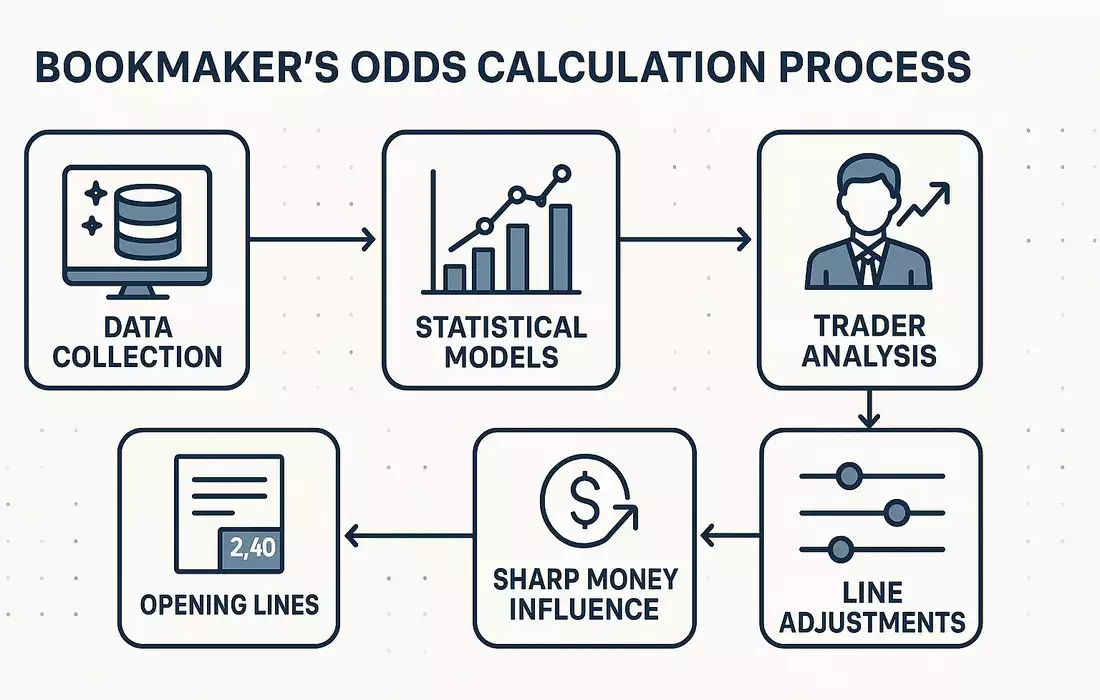
Trading firms also use sophisticated statistical models that process historical data to generate probability assessments. These models consider hundreds of variables and output probability estimates for various outcomes. The models aren’t perfect—no model can account for every possible factor—but they’re good enough to serve as starting points for opening lines.
Opening lines typically appear days or even weeks before events. These early lines are educated guesses based on model outputs and trader expertise, but they’re not the bookmaker’s final opinion. They’re more like trial balloons designed to gauge market reaction and attract early betting action that provides information.
Sharp bettors—professional gamblers who win consistently—often bet into opening lines if they disagree with the bookmaker’s assessment. Their bets carry information value because sharp money tends to be smart money. If a respected bettor immediately bets $50,000 on one side of a game, bookmakers take that seriously and might adjust the line before public bettors arrive.
As more information arrives—injury reports, weather forecasts, lineup announcements—bookmakers update their probability assessments and adjust odds accordingly. If the starting quarterback gets injured in practice, the odds shift immediately to reflect the changed circumstances. This is basic risk management, not inside knowledge.
The Over-Round: Building in Profit
Here’s where bookmakers stop trying to predict outcomes accurately and start ensuring they profit regardless of results. The over-round (also called overbook or vigorish on the book) is the mathematical mechanism that guarantees bookmaker profit.
Take a simple example: a soccer match between two evenly matched teams where a draw is possible. True fair odds might be 3.00 for the home win (33.33%), 3.00 for the draw (33.33%), and 3.00 for the away win (33.33%). These odds total exactly 100% probability.
But bookmakers don’t offer those odds. They might offer 2.80 for home (35.71% implied probability), 2.90 for draw (34.48%), and 2.80 for away (35.71%). If you add up those implied probabilities, you get 105.9%, not 100%. That extra 5.9% is the bookmaker’s margin—the over-round.
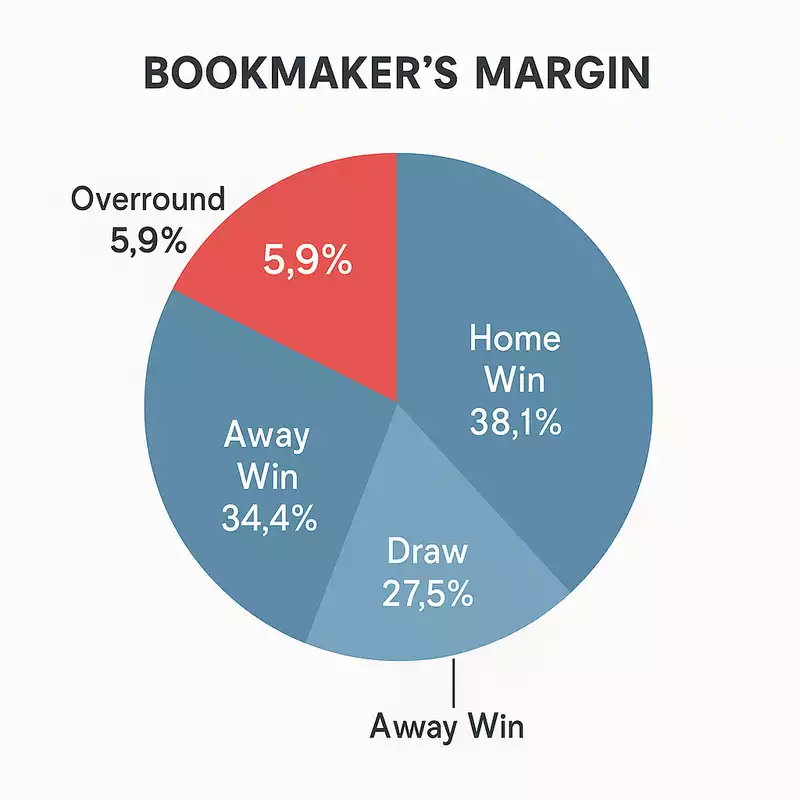
This means that if the bookmaker takes equal action on all three outcomes, they’re guaranteed profit. Suppose they take $1,000 on each outcome ($3,000 total). When the game ends, they pay out $2,800 to the winners (their $1,000 stake plus $1,800 profit at 2.80 odds). The bookmaker keeps $200 regardless of which team wins or whether the match draws. That’s $200 profit on $3,000 in total bets, which is 6.67% margin.
The math works identically in two-way markets like American sports. An NFL point spread typically shows -110 on both sides. Converting -110 to decimal gives 1.91, which implies 52.38% probability. Two 52.38% probabilities sum to 104.76%—that 4.76% over-round is where the bookmaker’s edge comes from.
The beauty of this system from the bookmaker’s perspective is that they don’t need to predict outcomes correctly. They just need to balance their book so they have roughly equal liability on each outcome. When they achieve that balance, the over-round guarantees profit.
The Vigorish: Your Cost of Betting
Vigorish—shortened to vig or juice—is the fee you pay to place bets. It’s built into the odds rather than charged separately, which makes it less obvious than the commission you’d pay a stockbroker, but it’s fundamentally the same thing. You’re paying for the privilege of betting.
A standard point spread or total at -110 on both sides carries roughly 4.5% vigorish. That means if you bet randomly on these markets (50% win rate over many bets), you’ll lose about 4.5% of your total amount wagered due to the vig. Bet $10,000 across 100 bets and you can expect to lose about $450 to the vig even before accounting for whether your picks are actually any good.
This is why winning 55% of your bets at standard -110 odds is considered excellent for professional bettors—you’re overcoming the vig and generating actual profit. Winning 50% breaks you even on outcomes but loses money to the vig. Winning 52.38% lets you break even including the vig. Everything above that is profit.
The vig varies dramatically across markets and bookmakers. Low-margin markets like NFL point spreads might carry 4-5% vig at sharp books. High-margin markets like parlays, teasers, or exotic props can carry 15-30% or even higher. Bookmakers charge more vig on markets where they have less certainty about true probabilities or where betting volumes are lower.
Understanding vig lets you calculate the “no-vig” or “fair” odds that would exist without the bookmaker’s margin. This is useful for comparing odds between bookmakers and identifying which offers the best value. If one book offers -110 and another offers -105 on the same bet, the difference is pure value—same outcome, lower fee.
Some bookmakers advertise “reduced juice” or “low vig” as selling points, offering -105 instead of -110 on standard markets. This seems like a small difference—five points on a -110 bet—but it compounds significantly over hundreds of bets. Over a year of regular betting, reduced juice can save thousands of dollars in aggregate vig payments.
Balancing the Book: Theory vs Reality
The ideal scenario for bookmakers is a perfectly balanced book where they have equal liability on all possible outcomes. In this perfect world, they collect the vig regardless of results, taking zero risk on the actual event outcome. This is the theoretical model you read about in textbooks and introductory guides.
Reality is messier. Perfect balance is difficult to achieve on many markets and sometimes undesirable even when possible. Bookmakers constantly manage risk exposure across thousands of simultaneous events, and they make strategic decisions about when to chase balance versus when to take positions.
Line movement is how bookmakers attempt to balance unbalanced books. If they open a line and immediately see heavy betting on one side, they adjust the odds to make the other side more attractive. This encourages bets on the underbet side, moving them back toward balance. A line might open at Patriots -7, get heavy action on the Patriots, and move to -9 or -10 within hours.
Sharp bettors pay obsessive attention to line movement because it reveals information. If a line moves significantly without obvious news (no injury reports, no weather changes), it suggests smart money is betting one side heavily. Following that sharp action can be profitable because professional bettors generally know something the public doesn’t or have spotted value the market initially mispriced.
Steam moves are dramatic line changes that happen rapidly across multiple bookmakers simultaneously. This occurs when a respected sharp bettor or betting syndicate places large bets on one side, causing the original bookmaker to adjust their line sharply. Other bookmakers see this movement and adjust their lines proactively to avoid getting picked off by other sharps who noticed the same opportunity. Steam moves can shift lines by multiple points in minutes.
Taking Positions: When Bookmakers Gamble
Sometimes bookmakers deliberately leave lines unbalanced when they believe the betting public is wrong. If they see heavy public action on one side but their analysis suggests the other side is more likely to win, they might let the book stay unbalanced and effectively bet against their customers.
This is riskier than maintaining balance, but it’s potentially more profitable. If the bookmaker’s assessment is correct and the public loses, the book keeps both the action from losing bets and the counter-action from winning bets. The margin is larger than it would be on a balanced book.
Sophisticated bookmakers do this selectively on markets where they have high confidence in their assessment and where the public is demonstrably biased. Public bettors love betting favorites and overs—this is well-documented through decades of betting data. Bookmakers sometimes shade their lines to exploit these biases, knowing they’ll get unbalanced action but believing the unbalanced side is more likely to lose.
The flip side is that when bookmakers take positions and get it wrong, they lose money. A massive upset where the public side wins and the sharp side loses costs bookmakers significantly more than they’d lose on a balanced book. This is why truly sharp bookmakers like Pinnacle focus on balancing rather than position-taking—they’re playing the long game of collecting vig, not trying to out-handicap their customers.
Factors Influencing Odds Beyond Probability
If odds setting were purely mathematical, all bookmakers would offer identical odds on the same events. They don’t, because subjective factors influence pricing beyond cold probability assessment.
Team and player popularity creates line shading. The Dallas Cowboys, New York Yankees, and Los Angeles Lakers reliably attract more public betting than market share would predict. Bookmakers know this and often shade lines against these teams, making them slightly less favorable to bet on. The public bets them anyway because of emotional attachment, and the bookmaker collects extra margin.
Same principle applies to star players. A game featuring LeBron James or Patrick Mahomes attracts more casual betting action than games featuring less popular players. Props on these stars carry wider margins because bookmakers know they’ll get bet regardless of price. You’re paying a popularity tax when you bet on marquee names.
Home field advantage gets priced into lines, but the extent varies by sport and market perception. NFL home field is worth about three points on average, but that’s averaged across all venues. Playing in Denver at altitude or Seattle with the 12th Man crowd might be worth more. Playing in a neutral-feeling stadium might be worth less. Bookmakers adjust for these nuances based on historical data and current perception.
Weather significantly affects totals in outdoor sports but gets priced imperfectly because forecasts change. A total might open before weather forecasts are reliable, then move as forecasts develop. Wind particularly affects NFL passing games and baseball fly balls, sometimes dramatically. Bookmakers watch weather obsessively for this reason.
Motivation levels are the fuzziest factor and the one where bookmakers might get things wrong most often. Is a team already eliminated from playoff contention mailing it in? Is a star player resting for postseason? Is a coach on the hot seat desperate for a win? These human elements are hard to quantify but clearly affect outcomes.
Public perception can diverge significantly from reality, creating opportunities. If the media narrative hypes a team beyond what performance justifies, bookmakers might offer odds that assume rational assessment while public bettors bet the hype. This creates value on the undervalued side for bettors who can separate narrative from reality.
Finding Value: Where Your Edge Comes From
Value betting is the only sustainable path to long-term profit in sports betting. You can’t win by betting randomly or following hunches. You win by identifying situations where your probability assessment differs from the market’s implied probability in your favor.
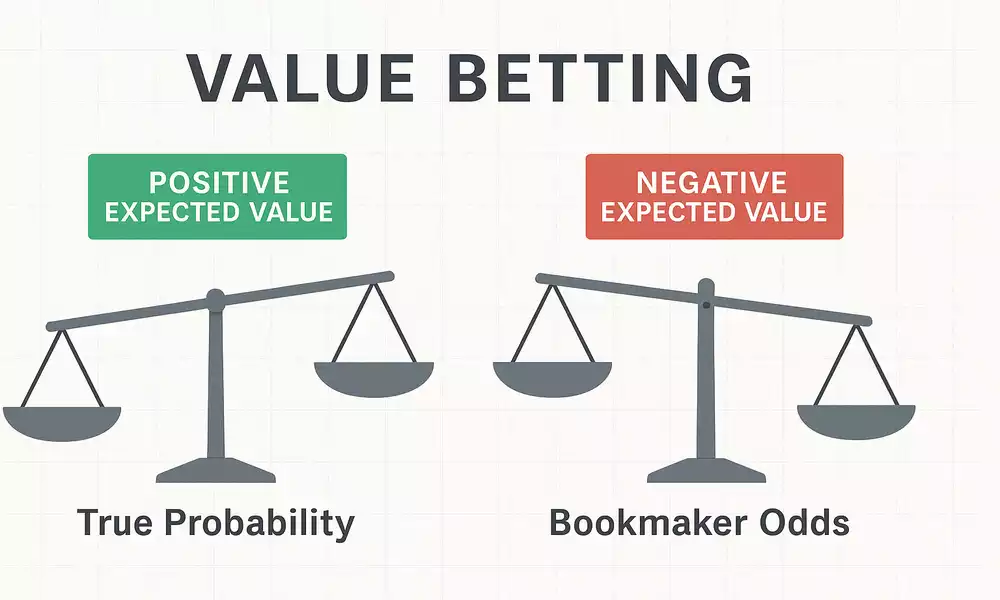
The concept is straightforward: if you believe an outcome has a 45% chance of happening but the bookmaker’s odds imply only 40% probability, you have a value bet. Even if you lose that specific bet (which happens 55% of the time in this example), betting repeatedly on similar edges produces profit over many iterations.
The math: at true 45% probability, fair odds would be 2.22 decimal (1 divided by 0.45). If the bookmaker offers 2.50 decimal (implied 40% probability), you’re getting better odds than the outcome deserves. Betting $100 at 2.50 returns $250 on wins. With 45% win rate and 55% loss rate, over 100 bets you’d expect 45 wins ($250 × 45 = $11,250) and 55 losses ($100 × 55 = $5,500), netting $5,750 profit on $10,000 total action. That’s 57.5% return on investment.
Of course, accurately assessing true probability is the hard part. If your probability assessments are no better than the bookmaker’s (or worse), you can’t identify value reliably. This is why most bettors lose long-term—they think they’re finding value but they’re actually just betting hunches against sharp lines.
Calculating Expected Value
Expected value (EV) is the mathematical formula for determining whether a bet has long-term positive or negative expectation. The formula is: (Probability of Win × Amount Won) – (Probability of Loss × Amount Lost).
If you bet $100 on an outcome you assess at 45% probability with 2.50 decimal odds: (0.45 × $150 profit) – (0.55 × $100 loss) = $67.50 – $55 = $12.50 positive EV. This bet expects to earn $12.50 per $100 wagered over many repetitions.
Most bets you see have negative EV because the vig ensures that randomly betting breaks you even on outcomes but loses you money to the fee. You need better assessment than the market to find positive EV opportunities consistently.
Tools for Finding Value
Odds comparison sites like Oddschecker and OddsPortal let you quickly see which bookmakers offer the best price on any given bet. This is the easiest form of value hunting—if five books offer 1.90 and one offers 1.95 on the same outcome, betting at 1.95 is obviously better value for identical risk.
Creating your own probability models gives you independent assessment to compare against market odds. This requires significant statistical knowledge and time investment, but serious bettors build models as their primary edge. If your model says 55% and the market implies 50%, you have theoretical edge.
Betting exchanges like Betfair show you what odds people are willing to bet at in peer-to-peer markets. Exchange odds often reflect true probability more accurately than bookmaker odds because there’s no built-in margin—people bet what they genuinely believe fair odds should be. If bookmaker odds are significantly worse than exchange odds, it suggests the bookmaker has built in extra margin.
Betting Against the Public
The public loses money long-term, which means fading popular public sides can be profitable. If 80% of bets are on one team but the line hasn’t moved significantly, it suggests the bookmaker is happy to take that unbalanced action because they believe the public is wrong. Betting the unpopular side in these situations often offers value.
Tracking public betting percentages (available from several websites) and comparing them to line movement reveals when smart money contradicts public opinion. If 75% of bets are on Team A but the line moves toward Team B, professional money is overwhelming the volume of public bets, and Team B likely offers value.
Why Odds Vary Between Bookmakers
Different bookmakers offer different odds on identical outcomes all the time. Sometimes the differences are small—a point or two on American odds. Sometimes they’re substantial enough that the same bet is positive EV at one book and negative EV at another.
Market positioning explains some variation. Pinnacle targets sharp bettors with low margins (1-2%) and sharp lines. They’re comfortable with sharp action because their models are excellent and they simply collect vig from everyone. Recreational sportsbooks target casual bettors with wider margins (5-7%) and less sharp lines. They lose to sharps occasionally but profit massively from public action.
Risk tolerance varies across operators. Some books aggressively move lines to stay balanced. Others hold their ground, taking positions when they believe their assessment is correct. This leads to price discrepancies—one book might move a line while another holds steady on similar betting patterns.
Information advantages are temporary but real. A bookmaker with excellent injury report sources might adjust a line before competitors react to the same news. These edges last minutes or hours until information spreads, but they create temporary price discrepancies.
Operational differences in how books manage risk lead to different pricing strategies. Some books share risk across global operations, letting them maintain tighter lines. Others operate independently in single jurisdictions, requiring wider margins for protection.
The practical takeaway is that line shopping—checking multiple bookmakers before placing every bet—is non-negotiable for serious bettors. The difference between -110 and -105 is worth $40-50 per $1,000 bet. Multiply that by hundreds of bets per year and you’re talking thousands in value just from shopping for better prices.
Live Betting: Odds in Real-Time
In-play betting represents the fastest-growing segment of sports betting and the most challenging for bookmakers to price accurately. Setting pre-game odds gives bookmakers days to analyze and adjust. Live betting requires pricing new markets every few seconds as game situations change, which is exponentially harder.
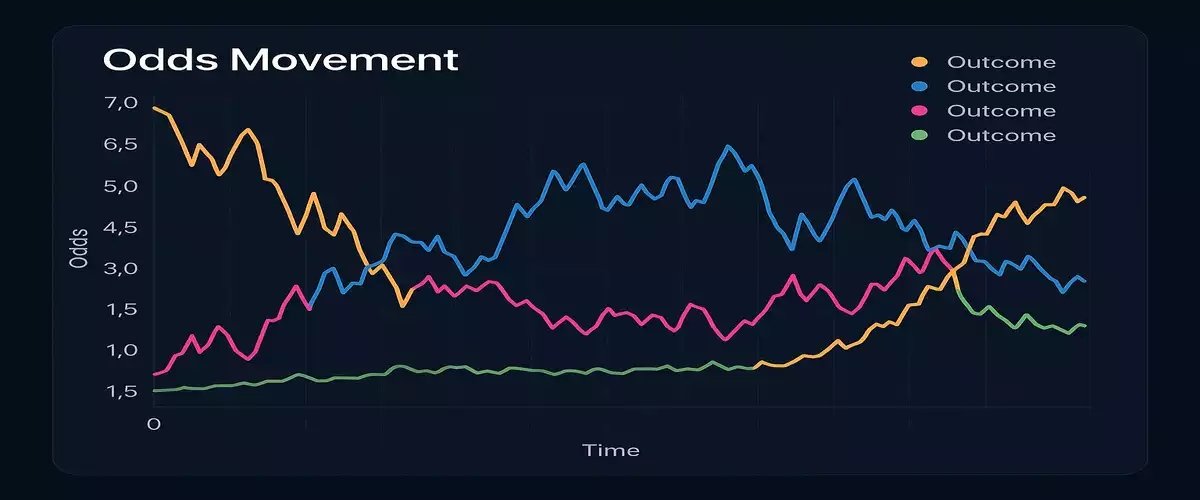
Live odds are set by algorithms that adjust mechanical probabilities based on score, time remaining, and current game state. These algorithms are sophisticated but imperfect, creating opportunities for sharp bettors who can process information faster than the algorithms adjust.
The margins on live betting are wider than pre-game markets—typically 6-8% versus 4-5% pre-game. Bookmakers charge more for real-time betting because their pricing is less reliable and their risk is higher. You’re paying extra for the convenience and excitement of betting during games.
Odds suspend frequently during live betting, particularly during critical moments. If there’s a potential scoring play in progress, bookmakers freeze the markets until the outcome is clear. They do this to prevent people betting on outcomes they can see happening on TV screens before the bookmaker’s feed updates. Attempting to bet suspended markets is futile—the bet won’t process until markets reopen with updated odds.
Sharp live bettors focus on identifying when algorithms overreact or underreact to events. A basketball team going on a 10-0 run might see their odds shift more than the situation warrants because the algorithm weights recent performance heavily. If you believe the run is variance rather than signal, betting against the algorithmic overreaction offers value.
Latency advantages are mostly dead in 2026. A decade ago, bettors with fast internet and quick reflexes could sometimes bet outcomes they’d seen on TV before bookmaker feeds updated. Modern bookmakers use delays and suspension systems that eliminate this advantage almost entirely. You’re not beating the book with faster internet anymore.
Common Misconceptions About Bookmaker Odds
The biggest myth is that odds represent bookmaker predictions of likely outcomes. They don’t. Odds represent prices designed to balance liability while ensuring profit margin. Bookmakers aren’t trying to predict the future perfectly—they’re trying to facilitate bets at prices that guarantee them money.
“The house always wins” is technically true but misleading. Individual bets lose for bookmakers constantly. Individual events sometimes see bookmakers lose money overall. But over thousands of events and millions of bets, the mathematical edge from vig ensures profitability. It’s the law of large numbers, not magic.
“Odds are designed to trick you” misunderstands the bookmaker’s business model. They’re not trying to trick anyone. They’re trying to set prices that attract action on both sides while building in margin. Sometimes public perception differs from reality, which bookmakers exploit through line shading, but that’s taking advantage of bias rather than trickery.
“Early odds are best odds” is sometimes true but often wrong. Early odds can offer value if bookmakers misprice markets before sharp action arrives. But early odds can also be wider and less sharp than closing lines because bookmakers leave room for adjustment. There’s no universal rule—sometimes early is better, sometimes late is better, and the only way to know is analyzing historical data for specific markets.
“Favorites always have value” is the opposite of reality. Public bias toward favorites means they’re often overbet and overpriced. Underdogs offer value more frequently than favorites in most markets, though not universally. Blindly betting underdogs isn’t a winning strategy either—you need actual analysis, not contrarianism for its own sake.
Understanding how bookmakers actually set odds destroys these myths and replaces them with accurate mental models of how the system works. That understanding is prerequisite to finding genuine edges and betting profitably over the long term.
Using This Knowledge Practically
Everything we’ve covered leads to practical applications if you bet regularly. Line shop religiously—never accept worse odds when better odds are available elsewhere. The cumulative savings from line shopping outweigh every other strategic betting decision you can make.
Focus on markets you genuinely understand rather than betting everything available. Specialization lets you develop expertise that the general market lacks. If you study NBA rotations obsessively and understand how coaching changes affect team performance, your assessment might be better than the bookmaker’s generic model. That’s your edge.
Avoid high-margin markets unless you have specific edge that overcomes the extra vig. Parlays, props, and exotic bets carry margins that make profit nearly impossible without substantial skill advantage. The juice is just too expensive.
Track every bet and calculate your actual return accounting for vig. Many bettors fool themselves about their performance by ignoring the costs baked into odds. Winning 51% of -110 bets is losing money overall once you account for vig. Honest accounting reveals whether you actually have edge or just got lucky temporarily.
The bookmaker’s business model is elegant and profitable because it’s built on sound mathematics that guarantee them edges over infinite repetitions. Your job as a bettor is finding situations where your probability assessment is better than theirs, and that only happens through genuine skill, information advantages, or exploiting market inefficiencies. Understanding how they set odds is the first step toward finding those opportunities.
Understand the math of the game on our homepage.
